

A few years ago, a friend of mine noticed a dark patch spreading behind her bathroom cabinet. She wiped it down with bleach, pushed the cabinet back against the wall, and figured that was the end of it. Three months later, her daughter started waking up with headaches and a stuffy nose every single morning. It took a doctor’s visit and an air quality test to connect the dots — the mold had never really gone away. It had just been waiting, hidden, growing.
That story isn’t unusual. In fact, it’s one of the most common ways mold problems get worse: a surface-level fix that gives you just enough confidence to stop looking deeper.
Mold Is More Than an Eyesore
Most people’s first instinct when they spot mold is to treat it as a cleaning problem. And honestly, that’s a reasonable assumption — it looks like grime, so you reach for the scrub brush. But mold isn’t dirt. It’s a living organism, and what you see on the surface is often just a fraction of what’s actually there.
Mold spreads through spores that travel through the air and settle into porous materials — drywall, wood, insulation, carpet padding. Once it gets a foothold in those materials, cleaning the surface does almost nothing to address the root of the problem. The structure beneath may be compromised, and the spores can continue circulating through your home’s air long after the visible patch has been wiped away.
The health implications are real and varied. Mold exposure has been linked to:
- Chronic respiratory issues, including worsening asthma and bronchitis
- Persistent allergy symptoms — sneezing, runny nose, itchy eyes — that don’t respond to typical treatments
- Headaches and fatigue that seem to have no clear cause
- Skin irritation and rashes
- In more serious cases, especially with black mold (Stachybotrys chartarum), neurological symptoms and immune suppression
Children, elderly people, and anyone with a compromised immune system are especially vulnerable. But even healthy adults can find their quality of life quietly eroding when mold is present and unaddressed.
Why DIY Removal Often Makes Things Worse
There’s a lot of confidence in a can of bleach and a pair of rubber gloves. And for truly minor, surface-level mold on non-porous surfaces — like a small patch on a tile — cleaning it yourself might be perfectly adequate. But once mold has penetrated porous materials, or once you’re dealing with an area larger than about ten square feet, the situation calls for a different approach.
Here’s the uncomfortable truth about DIY mold removal: disturbing mold without proper containment actually releases spores into the air. What was previously a localized problem can become an airborne one that spreads to other rooms. Without negative air pressure systems and professional-grade air filtration, those spores have nowhere to go except through your home’s ventilation and into your lungs.
There’s also the issue of incomplete removal. Most people clean what they can see and stop there. A professional mold remediation team assesses what you can’t see — they use moisture meters, thermal imaging, and air sampling to understand the full scope of contamination. Skipping this step is how mold comes back within weeks of a “clean.”
What Professional Remediation Actually Involves
Professional mold remediation isn’t just aggressive cleaning with better products. It’s a structured process that addresses containment, removal, treatment, and prevention as distinct steps.
Assessment and testing. A qualified remediator will start by identifying all affected areas — not just the obvious ones. This often involves air quality testing to measure spore counts, moisture mapping to find the water source feeding the mold, and a visual inspection of hidden spaces like wall cavities and crawl spaces.
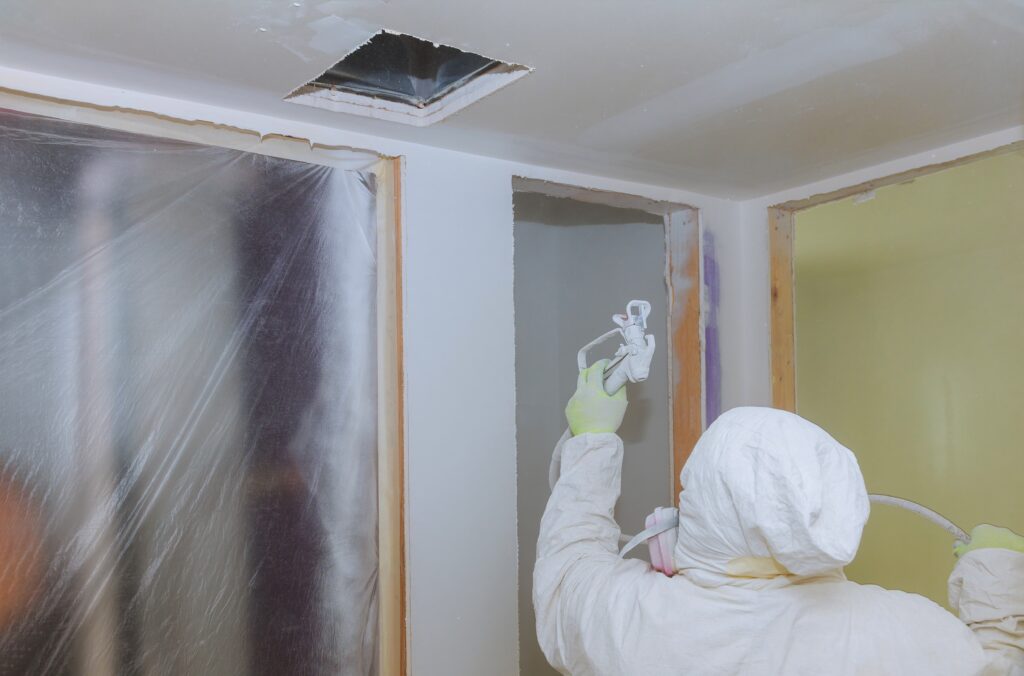
Containment. Before any removal begins, affected areas are sealed off using plastic sheeting and negative air pressure to prevent cross-contamination. This is a step that’s essentially impossible to replicate without professional equipment.
Removal and disposal. Infested materials — insulation, drywall sections, flooring — may need to be removed entirely. This isn’t overcautious; porous materials that have been deeply colonized by mold cannot be effectively sanitized in place. They need to come out.
HEPA filtration and air scrubbing. Industrial air scrubbers run continuously during and after remediation to capture airborne spores. The air you breathe during the process is actively filtered.
Treatment and encapsulation. Remaining surfaces are treated with antimicrobial solutions, and in some cases, structural elements are encapsulated to prevent future growth.
Post-remediation verification. A legitimate remediation company will test the air again after completion to confirm spore levels have returned to acceptable baselines. This is your evidence that the job was done properly.
Addressing the Source, Not Just the Symptom
One thing worth emphasizing: mold is always the result of moisture. It doesn’t appear out of nowhere. If professional remediation clears the mold but the underlying moisture problem — a slow pipe leak, inadequate bathroom ventilation, a foundation issue allowing water infiltration — isn’t resolved, mold will return. Every time.
Good remediation professionals will identify the moisture source as part of their assessment and either address it directly or give you a clear picture of what needs to be fixed before you can consider the problem truly resolved. If someone offers to handle the mold without discussing why the mold was there in the first place, that’s a red flag worth taking seriously.
The Cost of Waiting
People sometimes delay professional remediation because of the cost. It’s understandable — remediation isn’t cheap, and when your budget is already stretched, it can feel like something you’ll deal with “eventually.”
But mold doesn’t pause while you think it over. It spreads. And structural damage to wood framing, subfloor materials, and insulation compounds over time, turning what might have been a contained remediation job into a far more extensive and expensive renovation. Beyond the financial dimension, there’s the ongoing health exposure for everyone living in the home.
The calculus shifts pretty quickly when you frame it that way: paying now for professional remediation versus paying more — in money and in health — later.
Choosing the Right Professional
Not everyone who advertises mold removal has the training and equipment to do it properly. A few things to look for:
Certification. Look for remediators certified by the Institute of Inspection, Cleaning and Restoration Certification (IICRC) or the Indoor Air Quality Association (IAQA). These credentials indicate training in industry-standard protocols.
Separation of testing and remediation. Ideally, the company conducting your air quality assessment should be different from the one doing the remediation — or at minimum, post-remediation verification should be conducted independently. This prevents conflicts of interest.
Detailed written scope of work. Any reputable company should provide a clear, itemized plan before work begins, including what will be removed, what will be treated, and how success will be measured.
References and reviews. Mold remediation is the kind of work where previous customers’ experiences matter. Ask for references from similar jobs and read reviews carefully.
A Final Word
Your home is the environment you live in every day. The air quality inside it, the structural integrity of its walls and floors, the absence of hidden biological hazards — these aren’t abstract concerns. They affect how you sleep, how you breathe, how you feel.
Mold, left unaddressed or improperly addressed, quietly chips away at all of that. Professional remediation isn’t a luxury for people with perfectly maintained homes. It’s a practical, necessary response to a problem that rarely solves itself and almost never stays the same size.
For More Information about Green Guard Mold Remediation of Edison Contact us :
Business Name: Green Guard Mold Remediation of Edison
Address: 6 Kilmer Rd, Edison, NJ 08817, United States
Phone: 908-762-8046
Email: info@greenguardmoldremediationedison.com
Website: https://greenguardmoldremediationedison.com/
