

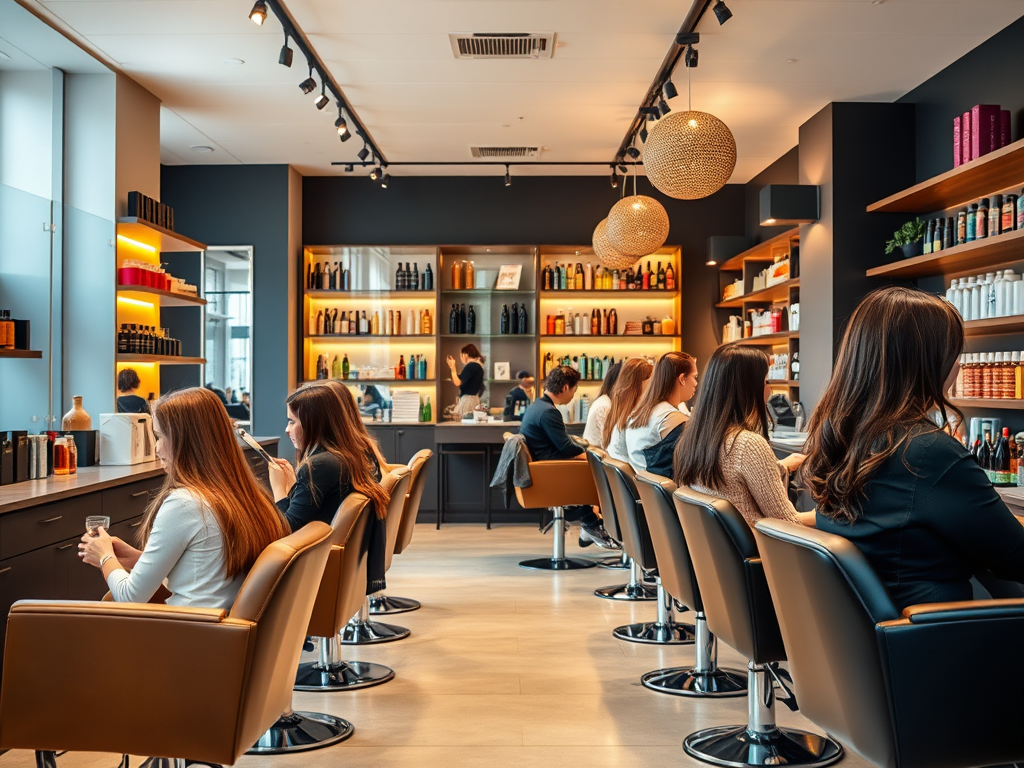
For much of its history, the hair salon was understood in fairly simple terms.
You arrived with hair that needed cutting, colouring or styling, spent some time in a chair, and eventually left with a finished look. The relationship between client and hairdresser was important, but the service itself was relatively straightforward.
That description feels increasingly incomplete today.
Modern salons have become places where technical expertise, personal advice, education and even conversations about long-term hair health come together. The appointment may still begin with a haircut or colour service, but the experience often involves considerably more thought than the final style suggests.
Part of this change has been driven by the way people now approach their appearance.
Clients are more informed than they were in previous generations. They arrive with photographs, references and questions collected from social media, magazines and conversations with friends. They may know the name of a particular technique before they have ever discussed it with a professional.
Yet having more information does not necessarily make choosing the right hairstyle easier.
In some ways, it has made professional guidance more valuable.
There is an enormous difference between knowing what you like and knowing whether it will work for you.
A photograph might show a beautiful haircut, but it cannot explain how that haircut behaves on a different texture. A colour might look perfect under studio lighting but require significant maintenance in everyday life. A style may look effortless online while actually depending on professional blow-drying and twenty minutes of preparation every morning.
This is where the modern hairdresser’s role becomes more interesting.
The stylist is no longer simply interpreting a request.
They are interpreting the person behind the request.
A good consultation can reveal more than a client initially expects. How much time do they have in the morning? Do they exercise regularly? Are they prepared to return to the salon every six weeks? Do they prefer their hair to look polished or relaxed? Have they previously experienced problems with colouring or chemical treatments?
These details influence the final recommendation just as much as the client’s preferred photograph.
The best salon experiences therefore begin with listening.
That may sound obvious, but listening is a surprisingly sophisticated professional skill.
A stylist needs to understand what a client is actually asking for, distinguish between the result they imagine and the result they genuinely need, and explain any differences without making the client feel dismissed.
Sometimes the best advice is to make a smaller change than originally requested.
Sometimes it is to wait.
Sometimes it is to choose a different technique entirely.
The ability to have those conversations is one of the characteristics that separates experienced hairdressing from simply following instructions.
This has also changed the idea of personalisation.
Personalisation does not necessarily mean creating something completely unique.
It can mean making a familiar haircut work specifically for one person.
The difference might be a slight change in length, a different distribution of layers, a modified fringe or a subtle adjustment to colour placement.
These small decisions can completely alter how manageable the finished style becomes.
It is often the invisible work that makes the result feel personal.
Another important development is the growing connection between salon services and haircare at home.
Historically, the salon and the bathroom cabinet were almost separate worlds.
The hairdresser performed the service.
The client then went home and used whatever products they happened to prefer.
That relationship has gradually changed.
Hairdressers now understand that the condition of the hair between appointments directly affects what can be achieved during future visits.
A colourist working with fragile, heavily processed hair has different possibilities from one working with healthy, well-maintained hair.
A stylist cutting curly hair needs to understand how the client cleanses, conditions and styles it at home.
A salon therefore has a vested interest in helping clients maintain their hair after leaving the chair.
This is not simply about selling products.
It is about continuity.
The appointment becomes one stage within a much longer process.
Professional haircare has consequently become more specialised.
Instead of a small collection of universal products, modern ranges often include treatments designed around specific concerns and textures.
Fine hair may need volume without weight.
Thick curls may need sustained moisture.
Colour-treated hair may require additional protection.
Mature hair may have different needs from younger hair.
This level of differentiation reflects a broader understanding of hair itself.
There is no universal definition of healthy hair.
Healthy-looking straight hair can have very different characteristics from healthy-looking curly hair.
A routine that creates beautiful volume for fine hair may be completely unsuitable for dense curls.
The modern salon therefore increasingly acts as a place of education.
Clients learn why their hair behaves as it does.
They learn how to use products correctly.
They discover which techniques are worth repeating at home and which are better left to professionals.
This educational element may be one of the most valuable services a salon can provide.
A good haircut that the client cannot maintain is only partially successful.
A good haircut accompanied by practical knowledge can continue working for weeks.
That is an important distinction.
It also explains why relationships between clients and hairdressers can become remarkably long-lasting.
People often stay with a stylist for years, sometimes decades.
The reason is rarely convenience alone.
Over time, the stylist learns the client’s preferences, understands their hair and remembers what has worked previously.
The client no longer needs to explain everything from the beginning.
There is a shared history.
That familiarity allows the service to become more precise.
The stylist knows when a client wants change and when they simply want their usual shape refreshed. They recognise when hair is behaving differently and can investigate why. They can also suggest new possibilities without making the client feel pressured to change.
This relationship is particularly valuable in an era of constant visual change.
Trends move quickly.
Personal style does not have to.
A professional can help clients borrow elements from current fashion without abandoning what makes their appearance feel authentic.
Perhaps this is the real evolution of the modern salon.
It is no longer simply somewhere people go to change their hair.
It is a place where people learn how their hair works, discover what suits their lifestyle and develop routines that make future decisions easier.
Some salons have taken this philosophy further by connecting their professional experience with the development of haircare products, allowing observations made in real salon environments to influence the products clients use at home. You can explore the Windle London website to see an example of a salon and professional haircare brand operating within this broader philosophy.
The finished haircut remains important.
So does the colour.
But these are only the visible outcomes.
Behind them is a much larger service built around consultation, experience, education and trust.
That may be why the most memorable salon visits are rarely remembered only for the hairstyle itself.
People remember being understood.
They remember receiving advice that made sense.
They remember leaving with hair that felt easier to manage.
And they remember returning months later and finding that the same professional still understands exactly what they need.
The modern salon may still have mirrors, chairs and scissors.
But its real value increasingly lies in everything that happens before, during and after the haircut.
